When several students listen to the same piece of music, their drawings can look completely different. Differences in colour, shape, detail and subject matter can give us an interesting look at how each student hears and responds to music.
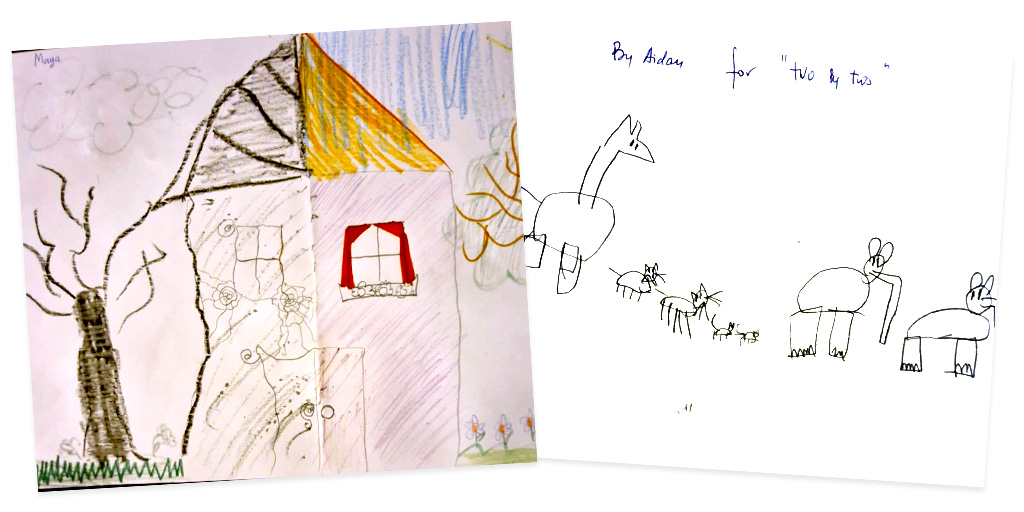
The Same Music, Different Drawings
When I ask students to draw in response to a piece of music, I never know exactly what I am going to see.
The music may be the same, but the drawings can be very different.
One student might draw a detailed scene with people, animals or objects. Another might fill the page with colour and movement. Someone else might use only a few simple lines or shapes.
I see this often in beginner piano lessons. Even when students are at a similar stage, they can have very different ways of listening to and imagining music.
In my beginner piano lessons in Brighton, these differences are one of the things I find most interesting about using drawing as part of music education.
What Changes from One Student to Another?
There are many things that can change from one drawing to another.
Colour is often one of the most obvious differences. One student may use bright, strong colours, while another may choose softer or darker colours.
Shapes and lines can also be very different. Some students draw clear objects or scenes. Others use circles, patterns, lines or shapes to show what they heard.
Detail is another interesting difference. Some drawings are full of small details, while others are very simple.
There is no need to decide that one drawing is better than another. The purpose is not to create the best artwork. The purpose is to give students a way to respond to music.
Literal and Abstract Responses
Students do not always draw what we might expect.
One child might hear a piece and imagine a story. They may draw a person walking through a forest, a storm, a house or another scene.
Another child listening to exactly the same music may draw colours, shapes and lines instead.
Both responses can be useful.
A drawing does not tell us exactly what a student is thinking or feeling. Instead, it gives the teacher something to talk about with the student.
We can ask simple questions such as:
- What did you hear in the music?
- Why did you choose those colours?
- Was there a part of the music that stood out to you?
- Did anything change while you were listening?
These questions can help students begin to talk about music in their own words.
What Can Drawings Tell a Teacher?
A drawing is not a test of musical understanding. It cannot tell a teacher everything about how a student hears music.
However, it can give us useful clues.
A student may notice a change in the music and show it through a change in colour or shape. Another may focus on a particular sound and draw something connected to it.
Young students may not yet know words such as dynamics, phrasing or musical character. They can still notice these things when they listen.
Drawing gives them another way to show what they noticed.
This can be especially useful in beginner piano lessons, when students are still building their musical vocabulary.
Listening Is Personal
We all hear the same piece of music, but we do not always notice the same things.
One student may focus on the rhythm. Another may notice a change in volume. Someone else may remember a particular melody or imagine a story.
This is part of what makes music interesting.
For young piano students, drawing can help bring these responses to the surface. Before they have the words to explain exactly what they heard, they can show some of their ideas through colour, shape and pictures.
The aim is not to tell students what the music means.
It is to give them space to listen and respond for themselves.
Developing an Individual Musical Voice
Learning piano is not only about playing the correct notes.
Students also need to learn how to listen, make choices and express an idea through music.
Creative activities such as drawing can support this process. They give students a chance to respond without worrying about playing the right note or giving the expected answer.
This does not replace technique. Technical skills are an important part of learning piano.
Instead, drawing can sit alongside those skills and help students build a stronger connection between what they hear and what they play.
A Small Collection of Different Responses
The drawings in this series are only a small selection of the work students have created over the years.
Some are detailed. Some are simple. Some are literal, while others are completely abstract.
What they have in common is that they began with listening.
The same piece of music can lead to very different responses, even when students are listening at a similar stage of their musical development.
That is one of the reasons I continue to use drawing in beginner piano lessons. It gives students a simple way to explore music, use their imagination and begin developing their own musical voice.
Experience It Yourself
Book a free trial lesson to explore how creative listening activities can help your child develop imagination and a personal connection with music alongside their piano technique.