Drawing to music in beginner piano lessons is introduced as a listening task, not as an art activity. From the beginning, students are told that the purpose is to listen carefully and respond honestly to sound, rather than to create a polished drawing. This distinction is important. It keeps the focus on music and removes any pressure to “perform” visually.
This article builds on the ideas discussed in Why Imagination Comes First in Beginner Music Education, but shifts the focus from why this approach matters to how it is used in practice.
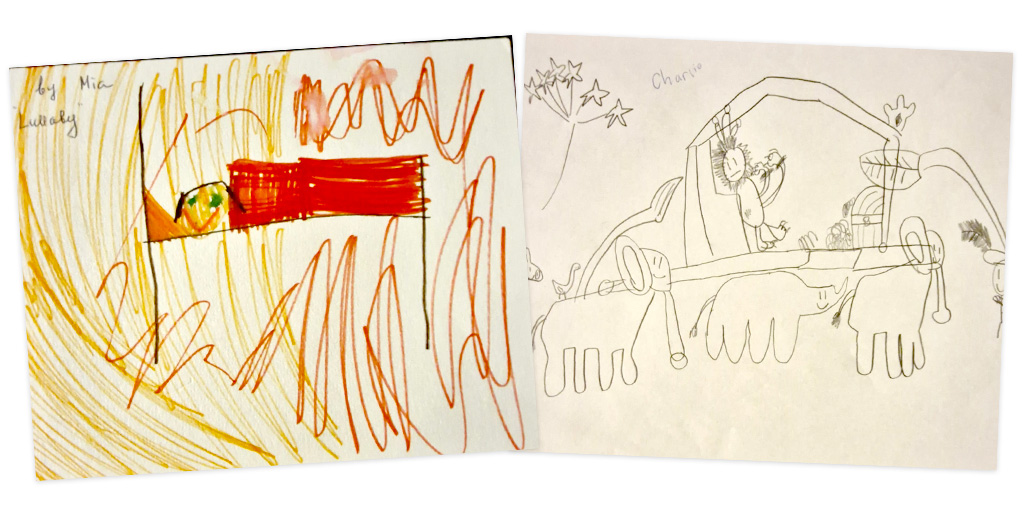
How Drawing in Piano Lessons Is Introduced
The task is kept deliberately simple. The teacher plays a short musical piece, usually one to two minutes in length. The student listens without being given descriptive prompts or instructions.
After listening, the task is explained in neutral language:
- Draw what you heard
- Draw what stood out
- Draw whatever came to mind
There is no mention of colour, emotion, story, or mood. This avoids leading the student toward a specific interpretation and allows their natural listening response to emerge.
In beginner piano lessons, this kind of open-ended task supports early musical engagement without requiring technical skill or musical vocabulary.
Using Drawing in Piano Lessons as a Listening Task
When drawing to music is used consistently, students begin to understand that listening is an active process. They are not simply hearing sound in the background; they are paying attention to changes, contrast, and character.
This method is especially effective for young beginners, who may not yet be able to describe music verbally or demonstrate understanding through playing. Drawing becomes a bridge between listening and later musical concepts such as phrasing and dynamics.
As part of creative listening in piano lessons, this task reinforces the idea that music has shape, energy, and direction – even before these ideas are named.
Why Drawing in Piano Lessons Works Well as Homework
Although drawing can be done during a lesson, it often works best as homework. Drawing to music homework encourages students to listen independently, without the influence of the teacher or the time constraints of a lesson.
When done at home:
- Students often listen more than once
- They control the pace of listening
- Their responses tend to be more personal
This shifts homework away from repetition alone and toward developing listening skills, which are central to long-term musical progress in beginner piano lessons.
Drawing in Piano Lessons: During Listening vs After Listening
There is a clear difference between drawings made while music is playing and drawings made after listening has finished.
Drawing during listening often highlights:
- Rhythm and motion
- Sudden changes in sound
- Immediate reactions
Drawing after listening tends to reflect:
- Overall mood
- Structure and balance
- What the student remembers most strongly
Both approaches are useful, but drawing after listening encourages reflection rather than reaction. For beginner students, this helps build focus and musical memory.
This distinction becomes important later in the series, particularly in Listening vs Hearing.
Literal and Imaginative Responses
Some students produce clear, literal drawings: scenes, objects, or characters that relate directly to what they hear. Others respond with abstract shapes, colours, or patterns.
Neither approach is corrected or ranked. Each reveals something different about how the student listens.
Literal drawings often show narrative thinking and strong associations. More abstract drawings often show sensitivity to contrast, intensity, and musical flow. These differences become especially clear when multiple students respond to the same piece of music, which will be explored further in Same Music, Different Worlds.
Why Drawing in Piano Lessons Matters Early On
Introducing drawing in piano lessons teaches students that listening is central to music-making. Before notes, before technique, and before theory, students learn that music is something to be experienced and understood internally.
This simple task lays the groundwork for expressive playing later on, when imagination, listening, and technique begin to work together at the keyboard.
Experience It Yourself
Book a free trial lesson to explore how drawing to music can deepen your or your child’s musical understanding.